Table of Contents
We live in the age of the expert. The cardiologist who knows everything about the left ventricle but nothing about the right knee. The software engineer who can build you a recommendation algorithm but can’t explain why people actually click on things. The marketing guru who understands consumer psychology but freezes when asked about the product they’re selling.
This isn’t a criticism. Specialization built the modern world. It gave us heart transplants and smartphones and supply chains that deliver bananas to Minnesota in February. But somewhere along the way, we made a trade. We gained depth and lost breadth. We learned everything about our little patch of ground and forgot that the world is round.
The polymath thinks differently. Not better, necessarily. Just differently. And in a world where the most interesting problems live at the intersection of disciplines, that difference matters more than ever.
The Forgetting Problem
Here’s something strange about how we learn. A biologist studies ecosystems and sees networks of feedback loops. A software architect studies systems and sees networks of feedback loops. An economist studies markets and sees networks of feedback loops. But these three people rarely talk to each other, and when they do, they often don’t realize they’re describing the same fundamental patterns.
This is the forgetting problem. We develop specialized languages that make us better at talking to people in our field and worse at talking to everyone else. The biologist says “trophic cascade.” The software architect says “cascading failure.” The economist says “contagion effect.” Different words, same concept.
The polymath’s first skill is recognizing these hidden symmetries. Not because they know everything, but because they’ve learned to translate between domains. They see the skeleton beneath the skin.
Connection Before Collection
Most people think being a polymath means knowing a lot of things. That’s like saying being a chef means owning a lot of ingredients. What matters is what you do with them.
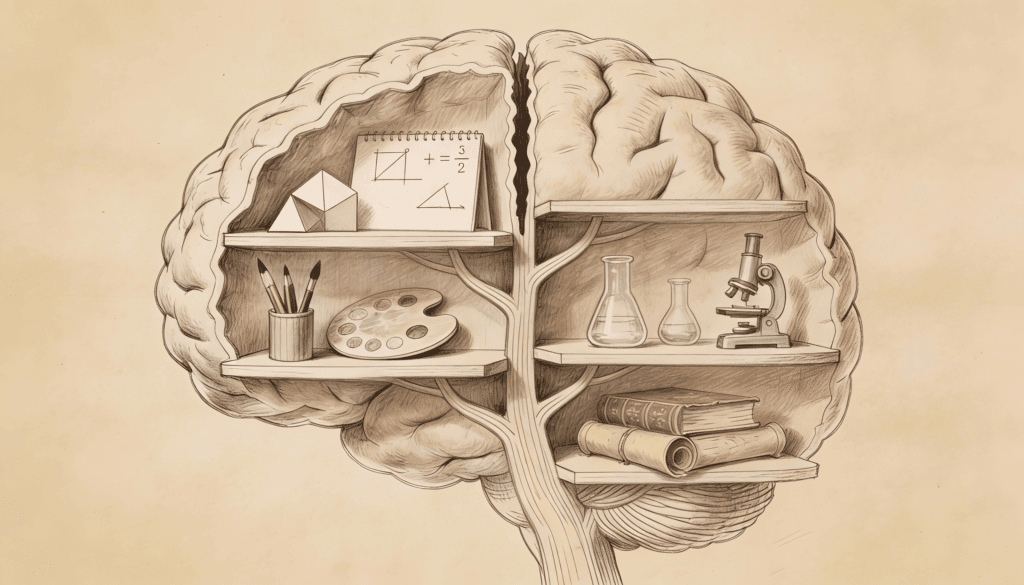
The traditional path of education trains us to collect facts. Capital of Mongolia? Ulaanbaatar. Powerhouse of the cell? Mitochondria. These facts sit in our brains like books on a shelf, nicely organized but rarely opened. We mistake the library for literacy.
Polymathic thinking starts with a different question. Not “what do I know?” but “what does this remind me of?” When you encounter something new, you don’t file it away. You hold it up to the light and turn it around, looking for where it connects to something you already understand.
A musician learns about wave interference and suddenly understands why some chord combinations sound rich while others sound muddy. An architect reads about ant colonies and rethinks how people move through buildings. A programmer studies linguistics and realizes that debugging code and parsing ambiguous sentences require the same cognitive moves.
These aren’t random associations. They’re structural insights. The polymath builds a web, not a wall.
The Power of the Beginner’s Eye
Experts often suffer from what psychologists call functional fixedness. They see things in terms of their standard use. A hammer is for hammering. A database is for storing data. A regulation is for preventing bad behavior.
The polymath, having been a beginner in many fields, remembers what it feels like to not know the “right” way to think about something. And this turns out to be incredibly valuable.
When Gutenberg invented the printing press, he wasn’t a book maker. He was a goldsmith who worked with metal punches. He looked at books with fresh eyes and thought: what if letters were just small metal objects that could be arranged and rearranged? The experts in book production, who spent years learning to copy manuscripts by hand, would never have asked that question. They were too close to the problem.
This pattern repeats constantly. The major breakthroughs in artificial intelligence came from people who studied neuroscience, not from people who studied existing computing paradigms. The revolution in data visualization came from a political economist, Edward Tufte, who started by asking why scientific charts were so terrible at actually communicating.
Being a perpetual beginner isn’t about ignorance. It’s about maintaining the ability to ask naive questions. The kind that make experts uncomfortable because they expose assumptions nobody thought to examine.
Learning to Think in Systems
Almost every field has discovered the same truth. Things are connected. Change one part and something else changes too, often in ways you didn’t expect. Push down on crime in one neighborhood and it pops up in another.
Specialists often understand these dynamics within their own domain. The epidemiologist knows about disease networks. The urban planner knows about traffic patterns. But the polymath sees that both are dealing with flow problems in complex systems. And that means solutions from one field might work in another.
This isn’t about superficial analogies. It’s about recognizing deep structural similarities. When you understand that traffic jams and data packet congestion follow similar mathematical laws, you can apply insights from computer networking to urban design. When you see that social media dynamics and epidemic spreading follow similar patterns, you can predict how information cascades form.
The specialist digs deep. The polymath digs wide. But the real insight comes from seeing that many deep holes eventually connect.
The Constraint Advantage
Here’s a counterintuitive idea. Specialists often have more freedom than they realize, but they’ve learned to stop seeing it.
Every field has its constraints, the things everyone agrees you “can’t” do. In architecture, you can’t build a structure that defies physics. True. But you also “can’t” put a highway through a building, except that actually happened, and now we have the Gate Tower Building in Osaka.
In music, you “can’t” make a piece with no instruments, except John Cage did that with 4’33”. In literature, you “can’t” write a novel without the letter E, except Ernest Vincent Wright wrote a 50,000-word book doing exactly that.
The polymath, having seen the arbitrary rules in multiple fields, develops a nose for which constraints are real and which are just conventions. This doesn’t mean being contrarian for its own sake. It means being able to distinguish between the laws of physics and the laws of habit.
Sometimes the most interesting innovations come from importing constraints from one field into another. Poetry’s restriction on line length and rhythm creates beauty through limitation. What if product design adopted similar constraints? Twitter’s 140 character limit wasn’t a bug. It was poetry’s influence on technology.
The Practice of Integration
So how do you actually think this way? It’s not about reading widely, though that helps. It’s about reading with intent.
When you learn something new, ask: what does this explain that I’ve seen elsewhere? A programmer learning about evolution might notice that both genetic algorithms and natural selection explore solution spaces through variation and selection. A teacher studying negotiation tactics might realize they’re already using similar principles when helping students resolve conflicts.
Keep a commonplace book, but not for quotes. For patterns. When you notice the same structure appearing in different contexts, write it down. Network effects in social media and in telephone systems. Feedback loops in thermostats and in anxiety. The 80/20 rule in business and in language frequency.
These patterns become thinking tools. When you face a new problem, you don’t start from scratch. You ask: what kind of problem is this? Is it a coordination problem? A signaling problem? A scaling problem? And suddenly you have access to solutions from every field where similar problems have been solved.
The Collaboration Multiplier
Individual polymaths are interesting. But the real magic happens when specialists learn to think polymathically about their collaborations.
The best research teams aren’t just collections of experts. They’re groups of people who can translate their specialized knowledge into concepts their collaborators can use. The biologist who can talk to the mathematician. The designer who can talk to the engineer. Not by dumbing things down, but by finding the shared abstractions that let different forms of expertise compound.
This is becoming essential. The problems we face are increasingly cross-domain. Climate change touches energy, economics, agriculture, politics, and psychology. Artificial intelligence involves computer science, ethics, cognitive science, and sociology. You can’t solve these problems from within a single discipline.
But you also can’t solve them by just putting specialists in a room together and hoping they figure it out. Someone needs to bridge. Someone needs to translate. Someone needs to see the connections that let different kinds of knowledge snap together.
That someone doesn’t need to be an expert in everything. They need to be comfortable with the grammar of multiple fields. They need to have built enough bridges that they know how to build another one.
The Resistance You’ll Face
Fair warning. Thinking this way will annoy people.
Specialists sometimes view generalists with suspicion. They see dilettantes. Superficial thinkers who know a little about everything and a lot about nothing. And sometimes they’re right. There’s a big difference between being a polymath and being a person who skims Wikipedia and thinks they understand quantum mechanics.
The difference is depth of understanding in multiple areas, not shallow knowledge of many areas. You don’t need to be an expert in ten fields. But you do need to have gone deep enough in at least two or three that you’ve developed real insight. Deep enough that you’ve seen the complexity. Deep enough that you’ve wrestled with hard problems. Deep enough that you’ve earned the right to make connections.
The polymath isn’t someone who knows everything. They’re someone who has learned to learn, who has seen enough different types of knowledge that they recognize the patterns that repeat.
Why Now
This way of thinking matters more now than it has in centuries.
For most of the 20th century, the big wins came from going deeper. We split physics into smaller pieces. We divided medicine into specialties and subspecialties. We created entire fields devoted to single types of molecules or single organs or single questions.
That work isn’t done. We still need specialists. But the low hanging fruit of pure specialization has been picked. The remaining problems are increasingly the ones that live in the gaps between fields.
How do we build AI that’s aligned with human values? That’s computer science and philosophy and psychology and political theory. How do we create sustainable cities? That’s urban planning and ecology and economics and sociology and engineering. How do we deal with misinformation? That’s media studies and cognitive science and game theory and technology.
These problems don’t respect disciplinary boundaries. Solving them requires people who can think across boundaries.
The Path Forward
You don’t become a polymath by trying to learn everything. You become one by learning how to learn, by building connections, by staying curious about how different fields approach similar problems.
Start with what you know. Take your expertise and ask where else its principles might apply. If you’re a designer, read about psychology. If you’re an engineer, study history. If you’re a writer, learn statistics. Not to become an expert, but to see how other fields think.
Look for the patterns that repeat. When you see the same structure in different domains, you’ve found something fundamental. Those patterns become tools you can apply everywhere.
Stay curious. The moment you think you’ve figured out how your field works is the moment you stop seeing the connections to everything else.
And remember that specialization and polymathic thinking aren’t opposites. They’re complements. The specialists who think polymathically become more valuable, not less. They can speak to other fields. They can integrate knowledge. They can see where their expertise connects to everything else.
The future belongs to people who can think deeply and broadly. Who can specialize and synthesize. Who can dig deep holes and also see how those holes connect.
That future is already here. The question is whether you’re ready to think your way into it.