Table of Contents
There’s a particular breed of entrepreneur who shows up at pitch meetings with perfect financial projections, immaculate market analysis, and a business plan that could make a McKinsey consultant weep with joy. Then they launch their startup and it dies within eighteen months.
Meanwhile, a college dropout who can barely spell “synergy” builds a company worth millions by solving a problem they noticed while ordering pizza.
This isn’t luck. This is pattern.
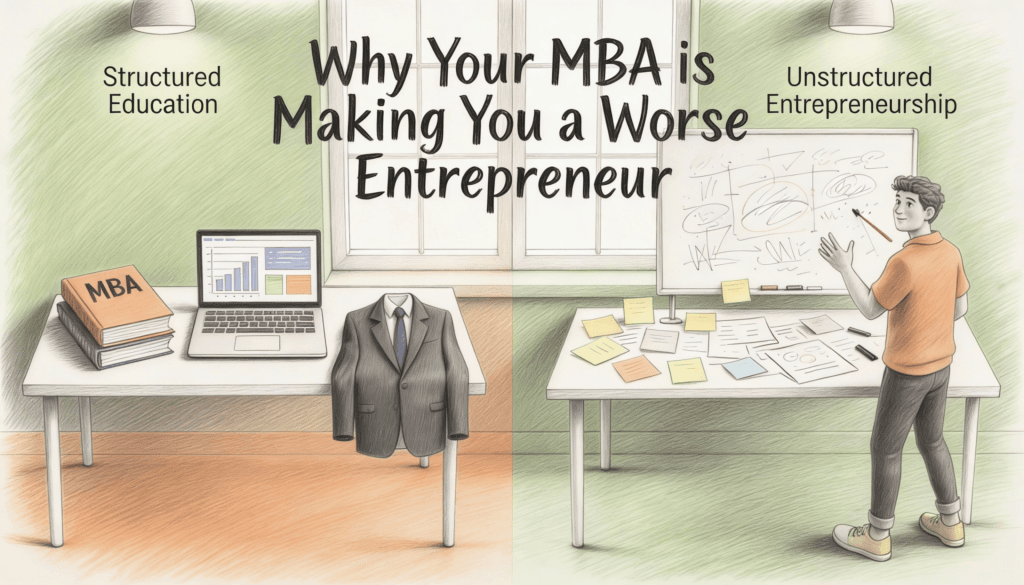
Business schools have created a curious paradox. They’ve become extraordinarily good at teaching people how to manage existing businesses while accidentally teaching them how to kill new ones. The very frameworks that help you optimize a mature company often poison the mindset needed to birth one from nothing.
Let me be clear: MBAs aren’t stupid. The education is rigorous. The networks are valuable. But something strange happens when you train someone to think like a professional manager and then expect them to act like a founder. It’s like teaching someone to be a museum curator and wondering why they can’t paint.
The Tyranny of the Business Plan
Business schools worship at the altar of planning. You learn to create detailed roadmaps for the next five years. You model every scenario. You build financial projections down to the decimal point.
This makes perfect sense if you’re running General Electric in 1965. It’s borderline delusional if you’re starting something new.
Real entrepreneurship is almost offensively messy. Twitter started as a podcasting company. YouTube was supposed to be a video dating site. Instagram began as a location check-in app cluttered with features until the founders stripped it down to just photo sharing.
If these founders had stuck to their original business plans with MBA-level discipline, none of these companies would exist as we know them. The plan wasn’t the point. The willingness to abandon the plan was the point.
But MBA programs teach you to view pivoting as failure. They reward consistency and execution against stated goals. This creates a psychological trap. When the market tells you that your idea is wrong, your training screams at you to push harder, optimize better, execute more precisely. The thought of throwing out eighteen months of careful planning feels like admitting defeat.
Actual entrepreneurs throw out plans before breakfast.
Analysis Paralysis in a Lab Coat
Business schools love frameworks. Porter’s Five Forces. SWOT analysis. Value chain analysis. Ansoff Matrix. Boston Consulting Group matrix. These tools are genuinely useful for understanding existing markets and making incremental decisions.
But they all share a fatal flaw for entrepreneurship: they require data that doesn’t exist yet.
How do you analyze competitive forces in a market you’re creating? How do you SWOT analyze a customer segment that doesn’t know it has the problem you’re solving? You can’t. So you make assumptions. And because you’re trained to make those assumptions look rigorous, you build elaborate castles of analysis on foundations of pure speculation.
This creates false confidence. You walk into a room with fifty slides of market analysis, and everyone believes you’ve done your homework. You’ve definitely done something. But you haven’t reduced your actual risk by a single percentage point, because none of that data was real.
Compare this to how successful founders actually work. They don’t analyze the market. They taste it. They build the smallest possible version of their idea and put it in front of real humans. When those humans react, the founders learn something true. Not true according to a survey or a focus group. True as in “a person just gave me money” or “a person just told me this is useless.”
This kind of learning feels primitive to the MBA mind. Where are the frameworks? Where’s the statistical significance? But it’s faster, cheaper, and more accurate than any amount of analysis.
The Risk Aversion They Don’t Admit To
Here’s something strange: MBA programs claim to teach entrepreneurship while systematically training people to fear risk.
Think about how business schools evaluate decisions. They teach you to calculate expected values. To diversify. To hedge. To never bet the company on a single move. This is smart if you’re managing other people’s money in a public company. It’s death if you’re trying to create something from nothing.
Real entrepreneurship requires irrational risk taking. Not stupid risks. But risks that don’t make sense on a spreadsheet. Jeff Bezos leaving a lucrative Wall Street job to sell books online looked insane by expected value calculations. So did the Airbnb founders selling cereal boxes to keep their company alive.
MBA training doesn’t prepare you for this kind of decision making. It prepares you to justify your decisions to a board. To show your work. To demonstrate that any reasonable person would have made the same choice.
But entrepreneurship rewards unreasonable choices. The entire game is about seeing something valuable that others don’t see. If your idea made perfect sense to everyone, someone with more resources would already be doing it.
Business schools accidentally select for and train people who are good at looking smart. Entrepreneurship rewards people who are willing to look stupid.
The Credential Trap
Getting an MBA means something. It signals intelligence, work ethic, and ambition. It costs significant money and time. This creates a psychological burden that entrepreneurs don’t need.
When you’ve invested two years and six figures in business school, you become attached to a certain kind of success. You need to justify that investment. Joining a failed startup or spending three years building something that generates barely enough to live on starts to feel like waste.
This is why so many MBA entrepreneurs aim too big, too fast. They’re not comfortable with small wins. They need the home run to justify the opportunity cost of business school and the salary they turned down.
Meanwhile, the most successful entrepreneurs often start with embarrassingly modest ambitions. They just want to solve their own problem or make enough to quit their day job. This gives them permission to start before they’re ready and to succeed at a scale that might disappoint an MBA graduate.
The credential becomes a cage. You can’t uninvest those two years or that money. So you make decisions based partly on justifying past choices rather than purely on what would work now.
Strategy Versus Tactics
Business schools teach strategy. Grand visions. Competitive positioning. Long term thinking. And they’re often dismissive of mere tactics or execution details.
This gets entrepreneurship exactly backward.
In the early stages of a company, tactics are everything. Strategy is mostly fantasy. You don’t know what business you’re really in yet. You don’t know who your real competitors are. You definitely don’t know your sustainable competitive advantage.
What matters is whether you can get your first ten customers. Whether you can build something people actually want. Whether you can convince someone to pay you money. These are tactical problems.
But MBA training makes you feel like focusing on tactics is beneath you. You’re a strategist. You think about market positioning and scalability and network effects. Meanwhile, you have four customers and your website keeps crashing.
The most successful entrepreneurs often look tactically obsessed to the point of absurdity. They personally call every early customer. They manually do things that don’t scale. They care deeply about tiny details that seem irrelevant to the big picture.
This isn’t because they can’t think strategically. It’s because they understand that strategy emerges from tactical success, not the other way around. You can’t strategize your way to product market fit. You have to grind your way there through a thousand small tactical victories.
The Employment Mindset
Here’s an uncomfortable truth: business school prepares you to be an excellent employee. A very senior, very well paid employee. But still an employee.
The entire curriculum assumes you’ll work within existing structures. You’ll have a budget. A team. Resources. Clear metrics for success. Someone else’s capital at risk.
Entrepreneurship has none of this. You have no budget. You are the team. Resources are whatever you can scrounge. Success metrics are whatever keeps you alive until next month. And it’s your own capital, or your friends and family’s, at risk.
This requires a completely different psychology. You can’t delegate. You can’t hire a consultant. You can’t wait for executive approval. You just have to do things, including things you’re not good at and don’t enjoy.
MBA training creates specialists. It teaches you to be excellent at one aspect of business and to rely on other specialists for the rest. But early stage entrepreneurs have to be generalists. You’re the CEO and the janitor and the customer service department.
Many MBA entrepreneurs struggle with this. They try to build a “proper” team too early. They hire people for roles that don’t need to exist yet. They create organizational structure before they have an organization.
This is expensive. But more importantly, it separates the founder from the actual work of building a company. You end up managing people who are doing the things you should be learning yourself.
When MBAs Actually Help
None of this means MBAs are useless for entrepreneurship. They’re just useful at the wrong time.
Once you’ve found product market fit, once you’re scaling, once you need to build systems and processes and manage complexity, that MBA education becomes gold. All those frameworks and analytical tools that were useless at the start become exactly what you need.
The problem is that most MBA entrepreneurs try to start at scale. They want to launch with the systems and processes and organizational design already in place. This is like trying to parent a teenager when you’re only in the second trimester.
Some of the best entrepreneurs actually do have MBAs. But they succeeded by ignoring most of their training in the early days and only pulling it out once they’d already built something that worked.
The Counterfeit Confidence Problem
Perhaps the deepest issue is this: MBA programs give you confidence in the wrong things.
They make you confident in your analysis. In your frameworks. In your ability to create impressive presentations. This feels like preparation for entrepreneurship. It feels like you’re ready.
But entrepreneurship doesn’t require confidence in your analysis. It requires confidence in your ability to be wrong and keep going anyway. Confidence that you can figure things out as they break. Confidence that you’ll survive looking foolish.
Business school gives you the confidence of someone who has done their homework. Entrepreneurship requires the confidence of someone who knows the homework was useless but shows up anyway.
This creates a particularly painful failure mode. MBA entrepreneurs often quit not because they’ve actually failed, but because they’ve failed according to their own projections. The business plan said they’d have a million in revenue by month eighteen. They have three hundred thousand. By MBA logic, this is failure. By entrepreneurial logic, it might be the beginning of something great.
The Path Forward
So what should MBA entrepreneurs do? Throw away the degree?
Not quite. But maybe treat it like a reference book rather than a bible. Pull it out when you need it. Ignore it when it’s getting in the way.
Start smaller than feels appropriate. Launch faster than feels comfortable. Be willing to do things that don’t scale. Ignore your financial projections. Talk to customers more than you analyze markets. Focus on tactics until strategy emerges naturally.
And maybe most importantly, give yourself permission to succeed in ways that wouldn’t look good in a business school case study. Building a small, profitable company that barely grows might feel like failure after spending six figures on an MBA. But it’s infinitely better than building an impressive sounding company that goes nowhere.
The best entrepreneurs who happen to have MBAs share one trait: they know when to forget what they learned. They can turn off the analysis. Stop optimizing. Quit planning. And just build something weird that probably won’t work but might.
Your MBA taught you to minimize risk and maximize the probability of success. Entrepreneurship requires you to take irrational risks on improbable successes. These aren’t just different skills. They’re opposed skills.
The question isn’t whether your MBA is making you a worse entrepreneur. It probably is. The question is whether you can unlearn enough of it to succeed anyway.