Table of Contents
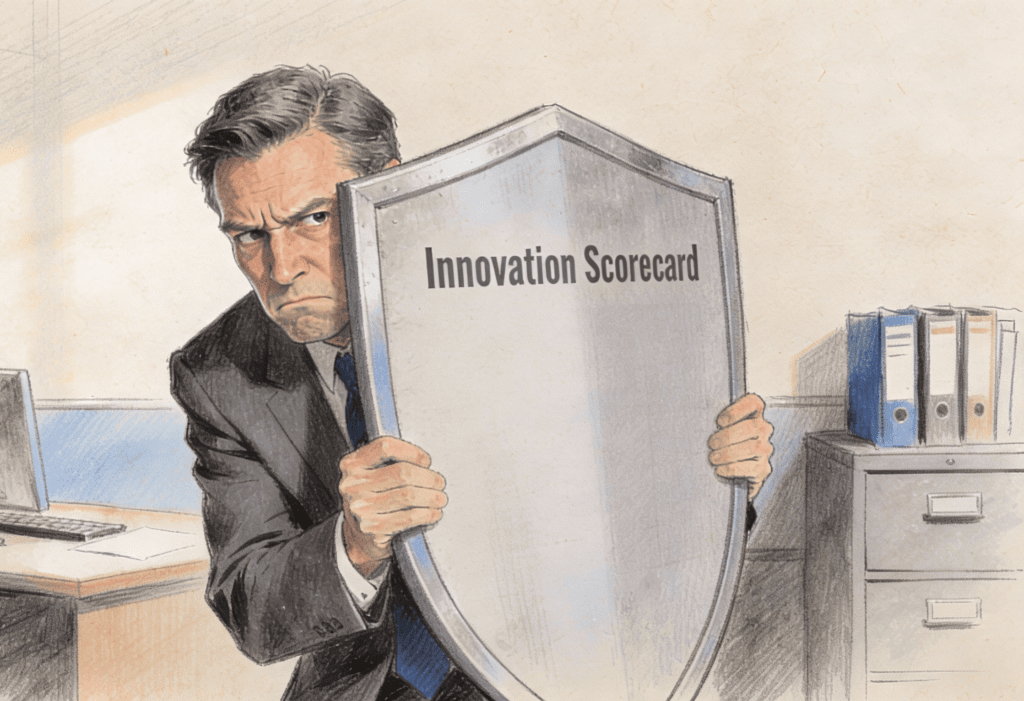
The innovation scorecard was supposed to be a compass. Instead, it became a bulletproof vest.
Walk into any large organization that takes innovation seriously, and you’ll find middle managers clutching their quarterly innovation metrics like talismans. They can tell you their ideation rate, their prototype velocity, their percentage of revenue from new products. They’ve got dashboards that would make a fighter pilot jealous. But ask them what they’re actually learning from all these numbers, and you’ll often get the corporate equivalent of a deer in headlights.
This isn’t because middle managers are incompetent or cynical. It’s because we’ve built a system that rewards the appearance of innovation more than the messy reality of it. And the scorecard, that well-intentioned tool meant to guide innovation efforts, has become the perfect instrument for this performance.
The Metrics Game Nobody Wins
Think about how a medieval knight used a shield. It wasn’t just for protection. It was also for display, painted with heraldry that announced who you were and what house you served. The shield’s primary function in peacetime was signaling.
Innovation scorecards have undergone a similar transformation. They were designed to help managers navigate uncertainty, to provide feedback on whether experiments were teaching the organization anything useful. But in practice, they’ve become elaborate signaling devices that say “I am doing innovation” to the people upstairs who control budgets and promotions.
The problem starts with a basic misunderstanding about what measurement can do. We borrowed the scorecard concept from other business functions where it works brilliantly. In manufacturing, you can measure defect rates and process times, then optimize them toward clear targets. In sales, you track conversion rates and customer acquisition costs, then pull levers to improve them. These systems work because the cause and effect relationships are relatively stable and well understood.
Innovation is different. By definition, you’re operating in territory where the map hasn’t been drawn yet. The whole point is that you don’t know what works. But organizations are uncomfortable with that level of uncertainty, so they create metrics that make innovation look as predictable as manufacturing.
A middle manager quickly learns that having good scores on the innovation scorecard is far more important than having good innovation. This isn’t paranoia. It’s pattern recognition.
When Success Becomes the Enemy
Here’s where it gets interesting. The metrics that appear on most innovation scorecards aren’t actually wrong. Tracking the number of experiments, measuring learning velocity, monitoring resource allocation to new initiatives, these are all reasonable things to pay attention to. The dysfunction comes from how the metrics are used.
Consider what happens when the scorecard becomes a target rather than a measurement tool. You get something economists call Goodhart’s Law: when a measure becomes a target, it ceases to be a good measure. Middle managers aren’t stupid. They quickly figure out how to game the system.
Need to show more experiments? Launch a bunch of tiny, safe projects that are almost guaranteed to succeed. Want better prototype velocity? Lower the bar for what counts as a prototype. Pressure to show learning outcomes? Write them in language so vague and positive that they’re unfalsifiable.
None of this is innovation. It’s innovation theater. But it scores well.
The truly insidious part is that this gaming doesn’t feel like cheating to the people doing it. It feels like survival. When your performance review is based partly on hitting your innovation targets, and hitting those targets requires running experiments that might fail, you face a logical impossibility. The only rational response is to redefine what failure means, or to ensure your experiments are in such safe territory that failure is unlikely.
So the scorecard becomes a shield. It protects you from looking like you’re not innovating. It gives you something to point to when executives ask what you’re doing about disruption. It provides cover for the uncomfortable fact that real innovation requires doing things that might not work, which is exactly the kind of uncertainty that scorecards were supposed to reduce.
The Paradox of Transparency
Organizations love transparency. They create elaborate systems to make everything visible. Innovation scorecards are part of this impulse. If we can see what everyone is doing, the thinking goes, we can coordinate better and make smarter decisions.
But transparency creates its own problems. When everything is visible, everything becomes performative.
Think about reality television. The cameras are supposed to capture authentic human behavior, but the presence of cameras fundamentally changes what people do. They become actors in their own lives, performing a version of themselves they think will play well to the audience. Innovation scorecards create a similar dynamic.
When middle managers know their innovation metrics are being watched, they optimize for what looks good on the scorecard rather than what might actually lead to breakthrough thinking. The scorecard doesn’t capture reality. It creates a new reality, one where the appearance of innovation becomes more important than the substance.
This is why some of the most innovative companies have deliberately fuzzy metrics for innovation work. They understand that too much clarity about how innovation will be measured leads to too much predictability in what gets tried. Real breakthroughs often come from pursuing hunches that wouldn’t score well on any sensible metric until after they succeed.
The Map That Makes the Territory
There’s a famous story about a general who sent reconnaissance teams into unfamiliar territory with topographical maps. The teams got lost repeatedly until someone realized they were using maps of the wrong mountain range. Yet the teams reported that the maps had been very helpful. They weren’t useful because they were accurate. They were useful because they were maps, period. They gave people a sense of structure and confidence that helped them organize their exploration, even though the details were completely wrong.
Innovation scorecards often work the same way. They’re wrong, but they’re useful for political reasons. They give executives the feeling that innovation is under control. They give middle managers a language for discussing work that is inherently difficult to describe. They create the illusion of progress in domains where progress is genuinely hard to assess.
The problem is that unlike those lost reconnaissance teams, organizations rarely discover their innovation maps are wrong. Why? Because they’re not really exploring. They’re following the map so religiously that they never venture into territory that would reveal the map’s limitations.
A real map helps you find your way through existing terrain. An innovation scorecard should help you figure out what terrain to explore next. But when the scorecard becomes a shield, it does the opposite. It keeps you on safe, well-trodden ground where the metrics are easy to hit.
What Middle Managers Know That Executives Don’t
Here’s something that doesn’t get said enough: middle managers are usually right to use scorecards as shields.
They’re operating in organizations that say they want innovation but punish the behaviors that lead to it. They’re told to take risks while being evaluated on predictable outcomes. They’re expected to challenge assumptions while being rewarded for meeting targets. These contradictions aren’t resolvable at the middle manager level. They’re baked into the system.
The real problem isn’t that middle managers are defensive. It’s that they have good reason to be.
Senior leaders often think they’re creating psychological safety for innovation by implementing scorecards that track experiments and celebrate learning. But psychological safety can’t be created through measurement systems. It comes from leadership behavior, from what gets rewarded when experiments fail, from whether people who try new things and fall short still get promoted.
Middle managers are experts at reading organizational culture. They know the difference between what gets said in all-hands meetings and what gets rewarded in performance reviews. When those two things don’t align, the scorecard becomes a way to demonstrate compliance with the stated values while actually optimizing for the real values.
This is why innovation initiatives led by middle managers so often feel hollow. The managers aren’t lacking creativity or commitment. They’re responding rationally to incentives that make real innovation professionally dangerous.
The Numbers That Don’t Count
Some of the most important information about innovation can’t be captured in a scorecard. The quality of a conversation. The moment when someone challenges a core assumption. The willingness to kill a project that’s not working even though it would hit its numbers. The decision to fund a weird idea that doesn’t fit any existing category.
These are the things that determine whether an organization can actually innovate. But they’re nearly impossible to measure, so they don’t appear on scorecards.
What happens instead is something like those studies where doctors spend more time looking at computer screens than at patients because that’s where the official data entry happens. Middle managers spend their time feeding the scorecard rather than doing the work the scorecard is supposed to measure.
The scorecard was meant to be a simplified representation of reality, a useful abstraction that helps you make decisions. But it has become a substitute for reality. The representation has replaced the thing it represents. This is dangerous because it means people stop checking whether the scorecard actually corresponds to anything meaningful.
You see this in how organizations talk about innovation. They’ll say things like “we increased our innovation score by twelve percent” as if innovation were a simple quantity that could be summed up in a single number. This is like saying you increased your health by twelve percent. It’s grammatically correct but conceptually incoherent.
Breaking the Pattern
If innovation scorecards have become shields, what should they be?
The answer isn’t to get rid of measurement. Organizations need some way to allocate resources and assess whether their innovation efforts are working. The answer is to recognize what scorecards can and can’t do.
A good innovation scorecard should make you uncomfortable. It should raise questions rather than answer them. It should highlight contradictions and uncertainties rather than smooth them over. If your scorecard makes everything look fine, it’s probably measuring the wrong things.
This means designing metrics that explicitly capture failure and learning, not just success. It means tracking the questions your experiments raise, not just the answers they provide. It means measuring whether people are exploring genuinely new territory or just repackaging existing work with innovation buzzwords.
Most importantly, it means senior leaders need to use scorecards differently. Instead of treating them as performance evaluation tools, treat them as conversation starters. Instead of asking “did you hit your innovation targets,” ask “what did you learn that surprised you” or “what assumptions did you test that turned out to be wrong.”
The moment executives start treating the scorecard as a shield test, checking whether managers are using metrics to hide rather than illuminate, the whole dynamic changes. Middle managers will stop optimizing for the appearance of innovation and start optimizing for the reality of it.
But this requires courage at the top. It means accepting that real innovation metrics will be messy, contradictory, and often disappointing. It means promoting people who take smart risks that don’t pan out, and being honest when innovation initiatives aren’t working rather than maintaining the fiction that everything is on track.
The Uncomfortable Truth
The reason middle managers use innovation scorecards as shields is that we’ve created organizations where that’s the rational thing to do. We say we want innovation while maintaining systems that punish it. We talk about learning from failure while rewarding only success. We claim to value experimentation while measuring people against predetermined targets.
Innovation scorecards aren’t the problem. They’re a symptom. They reveal something true about how organizations actually work, even when that truth is uncomfortable.
Until we’re willing to confront that disconnect between what we say we value and what we actually reward, scorecards will remain shields. They’ll continue to be tools that middle managers use to protect themselves from the contradictions built into their roles, rather than maps that help organizations navigate toward genuine innovation.
The good news is that once you see this pattern, you can’t unsee it. And once enough people acknowledge what’s really happening, it becomes possible to change it. But that change has to start at the top, with leaders willing to admit that their innovation systems might be creating the very behaviors they’re trying to prevent. That’s a hard truth to face.
However, the map is waiting to be drawn. But first, someone has to put down the shield.