Table of Contents
Most startup founders get pitching backwards. They lead with what they do, then explain how they do it, and if time permits, they mention why it matters. This approach puts investors to sleep faster than reading terms and conditions.
The problem is simple. People don’t buy what you do. They buy why you do it. This isn’t motivational poster wisdom. It’s how our brains actually work.
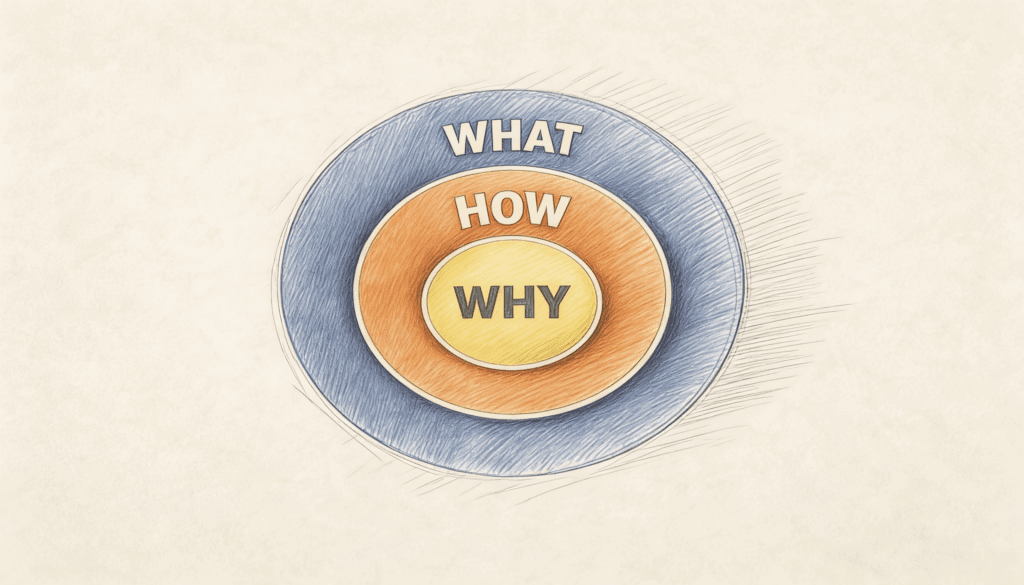
Simon Sinek introduced the Golden Circle framework years ago, and it remains one of the most powerful tools for structuring any pitch. The framework has three layers. Why sits at the center, surrounded by how, with what forming the outer ring. Start from the inside and work your way out.
This reversal changes everything.
Why Most Pitches Fail Before They Begin
Walk into any pitch competition and you’ll hear the same opening dozens of times. “We are a SaaS platform that helps companies manage their workflow through AI powered automation.” The investor’s eyes glaze over by the second sentence.
Here’s what happened. The founder jumped straight to what they built. They skipped the only part that actually matters at the beginning. Nobody cares about your product until they understand the problem that keeps you up at night.
Traditional pitching advice makes this worse. Pitch decks follow a formula. Company overview, problem statement, solution, market size, competition, business model, team, financials, ask. This structure seems logical. It’s also completely disconnected from how humans make decisions.
Neuroscience shows us something fascinating. When you pitch features and facts, you activate the neocortex. This part of the brain handles rational thought and language. But it doesn’t drive behavior. The limbic brain makes decisions. This ancient system responds to feelings, trust, and purpose. It has no capacity for language.
You can win the logical argument and still lose the investment. This happens constantly.
Starting With Why: The Core of Every Great Pitch
Your why isn’t your mission statement. It’s not about making money or disrupting an industry. Those are outcomes, not motivations.
Your why is the belief that drove you to start this company. The injustice you witnessed. The opportunity everyone else missed. The future you can see clearly that others think is impossible.
Consider how Airbnb could have pitched in their early days. The what pitch sounds like this: “We’ve built a website where people can rent out their spare rooms to travelers.” Functional. Forgettable. Commoditized.
The why pitch goes different: “We believe travel should help you belong anywhere. Hotels make you feel like a tourist. We think locals have amazing spaces and stories to share, and travelers want authentic experiences, not corporate lobbies. That’s why we built a platform connecting people’s homes with adventurous travelers.”
Same company. Completely different feeling.
The why pitch does something the what pitch never can. It reveals your worldview. Investors back founders who see the world differently and have the courage to act on that vision. They want to know if you’re building a company or just a product.
The Mistake of Leading With How
After fumbling the why, most founders jump to how. “Our proprietary algorithm uses machine learning to optimize user engagement through predictive analytics.”
Congratulations. You just told the investor absolutely nothing while using many words.
The how should explain your unique approach only after establishing why it matters. It’s your unfair advantage. The secret sauce. But secret sauce tastes like nothing when you don’t know what meal you’re eating.
Think about how rarely companies explain their how in consumer advertising. Apple doesn’t lead with processor speeds. They show you what creation looks like. Nike doesn’t explain shoe technology first. They show you what human potential looks like.
Your how becomes interesting only when framed by your why. If your why is making professional design accessible to everyone, then your how matters. “We’ve built an AI that understands design principles the way a human designer does, allowing anyone to create professional graphics through natural conversation.”
The technology serves the mission. Not the other way around.
What: The Proof Point, Not The Starting Point
Your what is evidence that you’re serious. It’s the tangible manifestation of your belief. But starting here is like showing someone your diploma before explaining what you studied or why you chose that field.
The what includes your product, your metrics, your traction. These details matter enormously. Just not first.
Here’s the interesting part. Once you’ve established why and how, investors lean forward when you get to what. They want the details now. They’re invested emotionally before you show the numbers. This is why some founders with modest traction raise large rounds while others with impressive metrics struggle.
The emotional buy in happened first. The data confirmed what they already felt.
Building Your Golden Circle Pitch
Let’s construct a pitch using this framework from scratch. Imagine you’ve built a platform for remote team collaboration.
The what pitch: “We’re a video conferencing platform with integrated project management, file sharing, and real time collaboration tools. We have 10,000 users and $50,000 in monthly recurring revenue.”
Not terrible. Certainly not memorable.
The Golden Circle pitch: “Remote work is now permanent for millions of people, but our tools weren’t designed for this reality. They were designed to replace in person meetings, not to build actual team culture. We believe remote teams can be more connected than office teams ever were, but only if we design for presence, not just for productivity.
That’s why we’ve built a platform that makes you feel like you’re working next to your team even when you’re continents apart. Instead of scheduling video calls, our system creates ambient connections that mirror how offices actually work. Quick questions happen instantly. You can see when someone’s deep in focus. Spontaneous collaborations emerge naturally.
We’ve proven this works. Teams using our platform report higher satisfaction scores than when they were in offices. We have 10,000 users across 200 companies, with 95% retention and growing 40% month over month.”
Same facts. Completely different impact.
The Counter Intuitive Truth About Passion
Here’s where founders get tripped up. They think starting with why means being passionate. They confuse enthusiasm with purpose.
Investors meet passionate founders constantly. Passion is table stakes. Everyone is passionate about their startup. You have to be, or you wouldn’t survive the early days.
What distinguishes great pitches is clarity of purpose, not volume of excitement. You can deliver your why calmly, almost matter of factly, and it lands harder than breathless enthusiasm about features.
The best pitches feel inevitable. This person saw something true about the world. They had to build this. There was no other choice. That certainty, delivered with quiet confidence, beats cheerleading every time.
Why The Golden Circle Works Beyond Pitching
The framework’s real power extends past fundraising. It shapes how you build your company.
Companies that start with why make better product decisions. When you’re clear on your belief, you know what features to build and which ones don’t serve the mission. Saying no becomes easier.
Your marketing writes itself. You’re not listing features. You’re inviting people who share your belief to join you. This creates customers who become evangelists.
Hiring improves dramatically. People don’t join companies for salary alone. They join movements. Your why attracts talent that believes what you believe. These people don’t need to be managed. They’re intrinsically motivated.
Even partnerships and business development benefit. When you lead with why, you attract partners who align with your mission rather than just seeing a transaction.
Common Mistakes When Applying The Framework
Understanding the Golden Circle doesn’t guarantee you’ll use it well. Here are the traps.
First, fake why. Some founders manufacture a noble sounding purpose that doesn’t match their actual motivation. Investors smell this immediately. Your why needs to be true, even if it’s not saving the world. Wanting to fix a frustrating personal experience is valid. Pretending you’re on a humanitarian mission when you’re building productivity software is not.
Second, vague why. “We want to make the world better” tells investors nothing. Better how? For whom? Your why should be specific enough that someone could disagree with it. If your why is universal and uncontroversial, it’s probably not actually your why.
Third, skipping what entirely. Some founders get so caught up in vision that they forget investors need evidence. The Golden Circle is a structure, not permission to avoid talking about metrics. You start with why, but you must get to what.
Fourth, mechanical application. The framework isn’t a formula where you say “Our why is X, our how is Y, our what is Z.” That’s just reorganizing bullet points. The framework should feel natural, like you’re telling a story that happens to have this structure.
The Neuroscience Behind The Model
Return to why this works. The limbic brain controls decision making but lacks language capacity. When you start with why, you speak directly to this system. You create an emotional response before the rational brain engages.
This isn’t manipulation. It’s alignment. You want investors who believe what you believe. Starting with why filters for this naturally. People who don’t share your vision will self select out. People who do will lean in.
The rational brain still matters. It needs to justify the emotional decision. That’s where how and what come in. But justification follows decision. This is backwards from what we’re taught, but it’s how humans actually function.
Studies on purchasing behavior confirm this pattern. People decide emotionally and justify rationally. You can see this in everything from car purchases to presidential elections. The candidate who connects emotionally wins, even if their policies are less detailed.
Adapting The Framework To Different Investors
Not every investor responds the same way. Stage matters. Risk tolerance matters. Industry focus matters.
Early stage investors care more about why. They’re betting on you and your vision. The what barely exists yet. Your clarity of purpose and unique insight matter most.
Later stage investors weight what more heavily. You should have proof of concept by now. But why still matters. They’re evaluating whether your vision can scale to a billion dollar company or if you’ve built a nice feature.
Industry matters too. Deep tech investors want to understand your technical how more than consumer investors do. But even in deep tech, why comes first. What problem in the universe demands this particular scientific breakthrough?
Practice Makes Permanent, Not Perfect
You won’t nail this framework on your first try. Your initial attempts will feel awkward. The structure will seem forced. This is normal.
Record yourself pitching. Watch it back without sound. Does your body language convey belief? Do you seem like you’re reciting or speaking from conviction?
Pitch to people outside your industry. If they understand your why and get excited despite not caring about your space, you’ve got it. If they’re confused or indifferent, your why isn’t clear enough yet.
Try the one sentence version. Reduce your entire pitch to a single sentence that captures your why. If you can’t do this, you don’t understand your own belief well enough yet.
Beyond The Pitch: Building With The Golden Circle
The framework should influence everything you create. Your website. Your hiring pages. Your product roadmap presentations. Customer onboarding.
Companies that master this become movements. Patagonia doesn’t sell jackets. They fight for the environment and make gear for people who share that fight. Tesla doesn’t sell cars. They accelerate sustainable transport and make vehicles for people who want that future.
Your startup can do the same at smaller scale. You’re not just building software or hardware. You’re advancing a belief about how the world should work. Everything you create should reinforce that belief.
The Ultimate Test
Here’s how you know if your Golden Circle pitch works. Tell someone your why. If they respond “That’s interesting, tell me more,” you’ve failed. If they respond “I completely agree, how are you doing it,” you’ve succeeded.
The right why creates instant alignment. People either get it immediately or they don’t. This self selection is valuable. You want to find your people, not convince skeptics.
When you’ve nailed your why, pitching stops feeling like selling. You’re simply sharing what you see and inviting others who see it too. The investors who say yes will be partners, not just funding sources. They’ll believe what you believe.
That shared belief carries you through the inevitable challenges every startup faces. It’s the difference between investors who panic at the first setback and investors who roll up their sleeves to help.
Start with why. Always. The companies that change the world don’t have better products. They have clearer beliefs and the courage to build them into reality. Your pitch should reflect that truth. Anything less is just feature lists and false promises.