Table of Contents
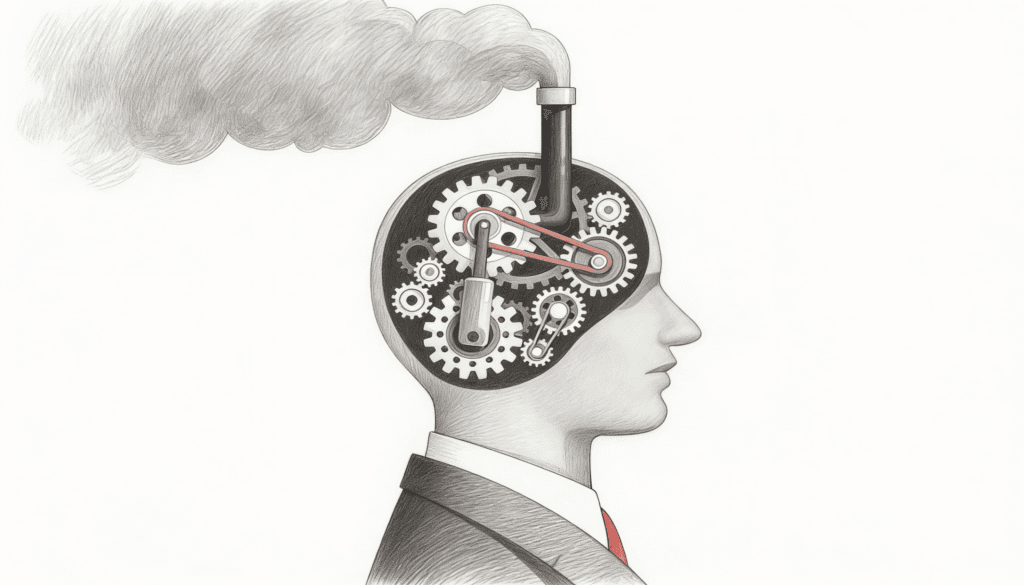
We measure everything in business. Customer satisfaction scores. Time to market. Cost per acquisition. Return on investment. We’ve become masters at quantifying the visible. Yet the most powerful force shaping whether your brilliant process innovation succeeds or fails remains largely invisible: the amount of mental effort it demands from the people who have to use it.
This is cognitive load. And it’s quietly killing more innovations than any competitor ever could.
The Paradox of Progress
Here’s something nobody tells you about process innovation. The more sophisticated your solution, the more likely it is to fail. Not because the idea is bad. Not because the technology doesn’t work. But because you’ve asked human brains to do something they’re fundamentally not designed to do: hold too many things in working memory at once.
Think about the last major process change at your company. Maybe it was a new project management system. Or a restructured approval workflow. Or an updated compliance procedure. The designers probably spent months perfecting it. They mapped every edge case. They built in flexibility. They added features for different scenarios.
And then it launched. And people hated it.
This happens so often we’ve normalized it. We blame “resistance to change” or “lack of training” or “poor communication.” These are real factors, but they’re not the core problem. The core problem is that we designed something optimized for logical completeness while ignoring the biological constraints of the human brain.
How Your Brain Actually Works
Your working memory, the mental workspace where you process new information and make decisions, can hold roughly four chunks of information at once. Not forty. Not fourteen. Four.
This number hasn’t changed since humans first walked upright. No amount of training, education, or motivation can expand it. You can get better at chunking information together, turning multiple small pieces into larger meaningful units. But the fundamental capacity remains fixed.
Every new process you introduce makes a claim on this limited resource. When you ask someone to remember a new login procedure, cross reference two different systems, consider multiple approval criteria, and format their request in a specific way, you’re not just adding steps. You’re exceeding the brain’s processing capacity.
What happens then? People fall back on shortcuts. They simplify in ways you didn’t intend. They skip steps that seem optional. They find workarounds that reduce their mental burden, even if those workarounds undermine your carefully designed system.
This isn’t laziness. It’s survival.
The Innovation Theater Problem
Most process innovation follows a familiar script. Leadership identifies an inefficiency. A team designs an improvement. They present a solution that looks impressive in PowerPoint. It has clear logic. It promises measurable benefits. Everyone nods in approval.
Then reality intrudes.
The people who actually have to execute this new process discover something the designers missed. The elegant workflow on the diagram translates to constant context switching in practice. The “simple” three step procedure requires remembering seven different pieces of information. The integrated system demands monitoring four different dashboards.
Within weeks, people develop shadow processes. Informal workarounds. The innovation exists on paper but not in practice. The measured efficiency gains never materialize. The project is quietly shelved or exists in a zombie state, technically implemented but functionally ignored.
We rarely diagnose the real problem because cognitive load is invisible. We can’t point to it in a meeting. It doesn’t show up in the project timeline. It doesn’t appear in the budget. So we blame other things, easier things, visible things.
Where Good Intentions Go Wrong
Consider the typical enterprise software implementation. The vendor demonstrates their product in a clean environment with sample data. Everything flows logically. The interface looks intuitive. The features seem powerful.
But when your team starts using it for real work, they’re not operating in that pristine demonstration environment. They’re juggling this new system alongside five other tools they already use. They’re handling exceptions the demo never covered. They’re trying to remember which field maps to which data source while on a video call while responding to an urgent message.
The software works exactly as designed. But the design ignored the reality of human cognition under actual working conditions.
This same pattern repeats across every kind of process innovation. We design for the ideal case and deploy into the chaotic reality. We optimize for theoretical efficiency and create practical cognitive overload.
The Measurement Gap
Here’s the uncomfortable truth. We’re terrible at measuring cognitive load because it’s largely subjective and internal. You can’t observe it directly. You can’t A/B test it easily. You can’t put it in a quarterly report.
So instead we measure what’s easy. Implementation timelines. Feature adoption rates. Cost savings. These metrics tell us the innovation is deployed. They don’t tell us if it’s actually working in the way that matters most: whether people can use it effectively without exhausting their mental resources.
This creates a dangerous gap. Leadership sees green lights on their dashboard while frontline workers experience red alerts in their neurons. The innovation is succeeding according to every official metric while failing in the only space that matters: human cognition.
What Actually Works
The best process innovations don’t add complexity. They remove it. They don’t expand options. They eliminate choices. They don’t enhance flexibility. They create constraints that make the right path obvious.
Look at how Amazon approaches checkout. They’ve spent billions reducing the cognitive load of buying something. One click purchasing. Saved payment methods. Default shipping addresses. Each innovation removes a decision, a step, a moment where your brain has to work.
This seems obvious for consumer products. We understand that friction kills sales. But we forget this principle when innovating internal processes. We assume our colleagues will tolerate complexity because they’re paid to use our systems. We’re wrong.
The most successful process innovations I’ve seen share a common quality: they make the complex simple, not the simple complex. They reduce the number of decisions required. They provide clear defaults. They automate the remembering so humans can focus on the thinking.
The Checklist Principle
Surgeons use checklists not because surgery is simple but because it’s complex. The checklist doesn’t dumb down the procedure. It frees cognitive resources for the judgment calls that actually require expertise.
This principle applies everywhere. When you’re innovating a process, ask: what here requires genuine human judgment, and what is just taxing human memory? The memory stuff should be automated, templated, or simplified into binary choices. Save the cognitive load for where it matters.
Yet most process innovations do the opposite. They automate the easy parts and leave humans to remember and coordinate the complex parts. This is backwards. Computers are excellent at remembering procedures and terrible at judgment. Humans are excellent at judgment and terrible at remembering procedures.
Design accordingly.
The Context Switching Tax
Every time someone has to switch between systems, contexts, or modes of thinking, there’s a cognitive cost. We tend to measure this in seconds—how long does it take to open a new application, pull up a file, or navigate to a different screen? But the real cost isn’t the seconds. It’s the mental effort required to reorient.
When you switch from writing an email to reviewing a spreadsheet to updating a project tracker, you’re not just changing windows. You’re changing mental models. You’re swapping out the information in your working memory. You’re rebuilding context.
This is exhausting in a way that’s hard to articulate. By the end of a day filled with context switches, people feel drained. Not because they did difficult work, but because their brain spent its energy constantly loading and unloading different contexts.
Process innovation that ignores this creates what I call workflow fragmentation. Each individual piece might be an improvement. But the whole requires so many context switches that the cumulative cognitive load exceeds what the individual pieces saved.
The Expertise Trap
Experts dramatically underestimate cognitive load for novices. When you’ve done something hundreds of times, it becomes automatic. You don’t consciously think through each step. You’ve chunked the entire procedure into a single intuitive action.
This creates a trap when experts design processes. What feels simple to them requires intense concentration for everyone else. They genuinely can’t see the difficulty because their expertise has made it invisible to them.
I watched this unfold at a financial services company. Senior analysts designed a new risk assessment process they considered straightforward. It had five main steps, each with a few substeps. In their minds, maybe twenty minutes of work.
For junior analysts, each of those substeps required looking up definitions, cross referencing multiple sources, and making judgment calls they didn’t feel qualified to make. What should have taken twenty minutes took two hours and generated constant anxiety. The process was technically correct. It was cognitively overwhelming.
The innovation failed not because of poor design in the traditional sense. It failed because the designers couldn’t accurately model the cognitive experience of the users.
Making It Stick
If you want your process innovation to actually work, to be adopted and sustained, you need to measure cognitive load as seriously as you measure any other metric. This is harder than measuring cost or speed, but it’s not impossible.
Watch people using your process in real conditions. Not in training. Not in demos. In the chaotic reality of their actual workday. Where do they pause? Where do they need to reference documentation? Where do they make errors? These moments reveal cognitive bottlenecks.
Ask people to verbalize their thinking as they work through the process. This think aloud protocol reveals what’s happening in working memory. When someone says “wait, where do I find that again?” or “which one am I supposed to use here?” they’re telling you they’ve hit cognitive limits.
Measure error rates and workarounds. When people consistently make the same mistakes or develop unofficial shortcuts, you haven’t failed to train them properly. You’ve exceeded their cognitive capacity.
The Path Forward
As AI and automation advance, we’ll have more opportunities to innovate processes. This is good news, but only if we learn the lesson. Technology should reduce cognitive load, not shift it around. Every automation, every integration, every enhancement should ask: does this make the human’s job mentally easier or just different?
The organizations that win won’t be the ones with the most sophisticated processes. They’ll be the ones whose processes demand the least cognitive overhead while achieving the most important outcomes. They’ll design for the biological brain, not the idealized worker.
Because at the end of the day, your innovation doesn’t exist in the abstract. It exists in someone’s working memory, competing for space with everything else they’re trying to think about. And if it demands too much space, it loses that competition every time.
The hidden metric isn’t hidden because it’s unknowable. It’s hidden because we haven’t prioritized making it visible. Start measuring cognitive load. Start designing for cognitive ease. Your innovations will finally stick.