Table of Contents
There’s a fantasy that most of us carry about innovation. We imagine a lone genius in a garage, or a team of brilliant minds locked in a conference room with whiteboards, methodically constructing the next big thing. Every piece fits perfectly. Every decision flows from a master plan. The future gets built the way you’d build a cathedral: stone by stone, according to blueprints drawn up in advance.
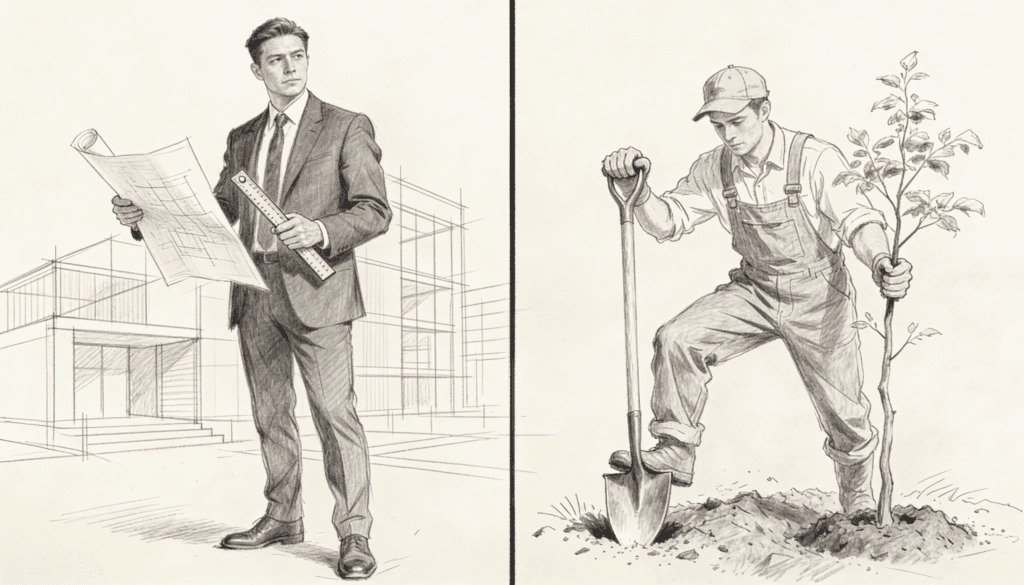
This is the architect’s dream. And it’s mostly wrong.
The truth about how breakthrough innovations actually emerge looks more chaotic. It resembles a garden more than a construction site. Seeds get planted, some thrive while others die, unexpected things cross-pollinate, and what grows often surprises even the gardener. This isn’t a poetic metaphor. It describes the fundamental tension between two approaches to innovation that every company, every research lab, and every ambitious project must navigate.
Call them closed innovation and open innovation. Or better yet: the architect versus the gardener.
The Seductive Logic of the Architect
The architectural approach to innovation makes perfect sense on paper. You identify a problem, assemble the smartest people you can find, give them resources and time, then protect them from distractions while they work. You build walls around your R&D department. You file patents to protect discoveries. You maintain strict confidentiality. The logic is simple: if you’re investing millions into developing something new, you want to capture all the value that emerges.
This model dominated the 20th century. Bell Labs invented the transistor this way. Xerox PARC created the graphical user interface. IBM built the personal computer. These weren’t collaborative community efforts. They were fortress operations where brilliant people worked in relative isolation, protected from the outside world.
And it worked. For a while.
The architectural model delivers something psychologically satisfying. It offers control, or at least the illusion of it. Management can draw org charts showing exactly who is responsible for what. Investors can tour facilities and see their money at work. There’s a clean narrative: we invest X dollars, our people develop Y technology, we patent it, we profit. The story has a beginning, middle, and end. Humans love stories with clear structure.
But reality rarely respects our desire for neat narratives.
When the Walls Became Prisons
The first crack in the architectural model appeared quietly. Companies realized they were sitting on piles of unused patents and shelved projects. Xerox famously invented technologies at PARC that it never commercialized. The graphical user interface ended up at Apple. The laser printer took years to reach market despite being technically ready.
This wasn’t incompetence. It was the inevitable result of architectural thinking. When you build walls to keep outsiders from stealing your ideas, those same walls prevent you from seeing opportunities outside your immediate vision. The R&D department becomes a fortress, but fortresses have limited sight lines.
Meanwhile, outside those walls, the world was changing. The internet arrived, connecting people across companies, universities, and continents. The cost of communication dropped to nearly zero. Suddenly, brilliant people weren’t locked inside corporate labs. They were everywhere, talking to each other, sharing ideas, building on each other’s work.
The gardener’s era had begun.
How Gardens Actually Grow
Open innovation isn’t really “open” in the sense of giving everything away for free. That’s a misunderstanding that has caused endless confusion. The gardener model recognizes something subtler: innovation rarely happens in isolation, and attempting to control every aspect of the creative process often strangles it.
Consider Linux. Linus Torvalds didn’t design an operating system behind closed doors and then release it to the world. He shared his initial code early, when it was incomplete and rough. Thousands of developers contributed. They found bugs, added features, adapted it for different purposes. Today Linux runs most of the internet’s servers, powers Android phones, and dominates supercomputing. No single company architected this. It grew.
Or look at Wikipedia. Experts predicted it would fail. How could an encyclopedia written by random internet volunteers compete with professionally edited alternatives like Britannica? The architecture of Britannica made sense: hire expert writers, employ rigorous editors, maintain quality control. Wikipedia’s garden approach seemed chaotic: let anyone edit anything, resolve disputes through discussion, trust that truth would emerge from collaborative effort.
Wikipedia won. Britannica stopped printing its encyclopedia in 2012.
The garden model succeeds by embracing what the architectural model fears: lack of complete control. Instead of trying to predict and plan everything, you create conditions where good things can emerge. You plant seeds, provide nutrients, remove obstacles, and see what grows.
The Unexpected Mathematics of Openness
You might think that opening your innovation process means giving away value. If you share your research, won’t competitors just steal it? If you let outsiders contribute, won’t they dilute your advantage?
The math works differently than intuition suggests.
When you open up your innovation process, you multiply the number of minds working on problems. Not just by hiring more people internally, but by tapping into the global pool of talent and creativity. That pool is massive, and most of it doesn’t work for you. The question isn’t whether you can afford to access it. The question is whether you can afford not to.
Pharmaceutical companies discovered this the hard way. Traditional drug development followed the architectural model: internal scientists working in secrecy, filing patents on compounds, guarding data carefully. The process took over a decade and cost billions per successful drug. Then the industry started experimenting with precompetitive collaboration. Companies began sharing early-stage research on disease mechanisms. They published negative results so other researchers wouldn’t waste time repeating failed experiments.
Counterintuitively, this openness accelerated everyone’s progress. The garden grew faster when multiple gardeners tended it, even when those gardeners technically competed with each other downstream.
The Architect’s Revenge
But before we declare total victory for the gardener, we should note where the architectural model still dominates and probably should.
SpaceX doesn’t crowdsource rocket designs. When you’re dealing with literal rocket science, where errors kill people and destroy hundreds of millions of dollars of hardware, you need architectural control. Elon Musk didn’t post an invitation on GitHub asking the internet to help build a reusable orbital rocket. He hired brilliant engineers and gave them clear specifications.
The same applies to most hardware innovation. You can’t iterate a jet engine the way you iterate software. The feedback loop is too slow, the costs too high, the safety requirements too stringent. Architecture wins when the price of failure is catastrophic and the integration challenges are immense.
Even in software, pure openness has limits. Companies like Apple maintain tight architectural control over hardware and software integration. The iPhone’s elegance comes from one company controlling the entire stack, making decisions that optimize the whole rather than individual pieces. This is classic architectural thinking, and it produces results that loose federations of independent developers struggle to match.
The architect hasn’t lost. But the architect’s domain has shrunk.
The Hidden Variable: Trust
The real difference between these models isn’t about control versus chaos. It’s about trust.
Architectural innovation assumes you can’t trust outsiders. They might steal your ideas. They might contribute poor-quality work. They might head in directions you don’t want. So you keep everything inside the walls.
Garden innovation makes a different bet. It assumes that most people, given the right incentives and structures, will contribute positively. Yes, there will be vandals and thieves. But their damage will be outweighed by the value that genuine contributors bring. And you don’t need everyone to contribute. You need a small percentage of talented, motivated people to care enough to help.
This is less naive than it sounds. Open-source software projects aren’t anarchist collectives. They have governance structures, core maintainers, quality controls. But these structures are lighter and more flexible than traditional corporate hierarchies. They rely on reputation, demonstrated competence, and community norms rather than job titles and org charts.
When Gardens Need Walls
The smartest organizations today don’t choose between these models. They use both, understanding when each applies.
Tesla open-sourced many of its patents, betting that faster electric vehicle adoption helps them more than jealously guarding intellectual property. But they didn’t open source their battery management software or manufacturing processes. Some things stay inside the walls.
The key is recognizing which parts of your innovation process benefit from openness and which require control. This isn’t always obvious. Companies often protect things that would be more valuable if shared, and share things they should protect.
The Identity Crisis
Here’s what makes this transition difficult: it requires organizations to rethink their identity.
If you’re an architect, your value comes from what you know that others don’t. Your competitive advantage lives in secrets. Opening up feels like giving away the store.
If you’re a gardener, your value comes from your ability to cultivate, curate, and integrate. Your competitive advantage lives in relationships, platforms, and ecosystems. Keeping secrets feels like building walls around a garden, blocking the sunlight.
Many companies get stuck between these identities. They want the benefits of openness without giving up control. They launch “innovation platforms” but restrict who can contribute. They publish research but only after carefully scrubbing anything valuable. They’re trying to have a garden party inside a fortress.
This doesn’t work. Half measures satisfy no one.
The Uncomfortable Question
This leads to an uncomfortable question for anyone building something new: Are you an architect because that’s what the problem requires, or because that’s what makes you comfortable?
Many organizations default to architectural thinking not because they’ve analyzed the trade-offs but because it’s familiar. Humans like control. We like clear boundaries. We like knowing exactly who is responsible for what. The architectural model satisfies these psychological needs.
But satisfying our need for control isn’t the same as actually achieving the best outcomes.
The gardener’s path requires accepting uncertainty, trusting others, and releasing control over outcomes. These feel risky. They are risky. But in an increasingly connected world where knowledge spreads instantly and talent is globally distributed, trying to maintain architectural control may be the riskier choice.
Building the Future
The debate between open and closed innovation isn’t about which is “better.” Both approaches work under the right circumstances. The question is matching the method to the problem.
If you’re working on something where integration is critical, safety is paramount, and the costs of failure are catastrophic, build like an architect. Draw clear plans. Maintain control. Move deliberately.
If you’re exploring unknown territory, where the solution isn’t clear and the path forward is uncertain, cultivate like a gardener. Plant many seeds. Welcome unexpected contributors. Let the ecosystem evolve.
Most importantly, recognize which game you’re playing. The worst outcome is trying to garden with an architect’s mindset or trying to architect with a gardener’s approach.
The future will be built by both architects and gardeners. But the balance has shifted. More and more, the biggest breakthroughs come not from fortress labs but from connected communities. Not from master plans but from emergent order. Not from controlling everything but from cultivating the right conditions for growth.
The question isn’t whether to build walls or tend gardens. The question is knowing when each serves the future you’re trying to create.