Table of Contents
We’ve been sold a beautiful lie about innovation. The lie says that breakthrough ideas come from brilliant thinking, from raw cognitive horsepower, from the lone genius having their eureka moment in the bathtub. We celebrate the spark of inspiration, the flash of insight, the moment when everything suddenly clicks.
But here’s what nobody tells you: thinking is cheap. Ideas are abundant. What actually matters is digestion.
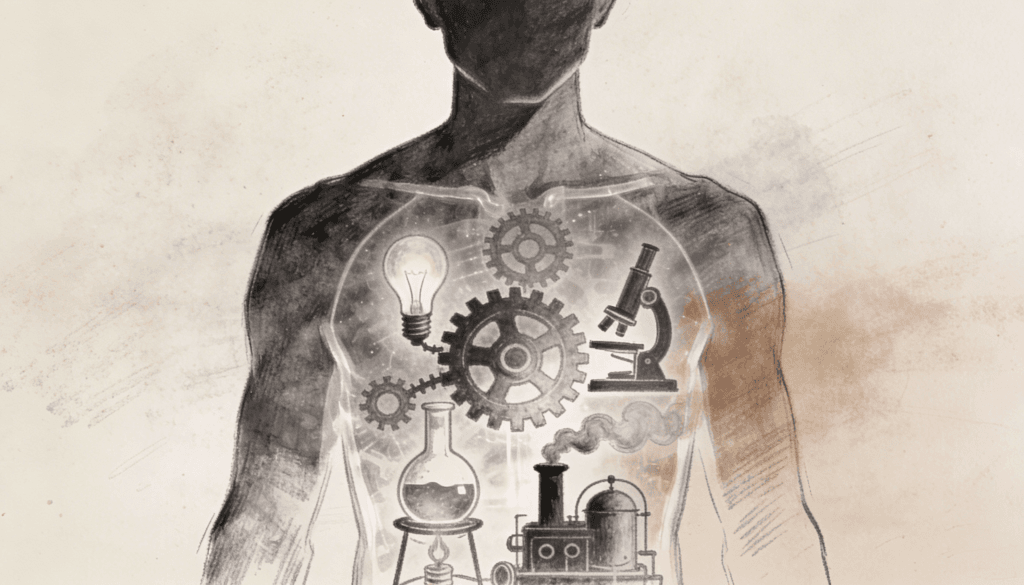
Consider what happens when you eat a meal. The food on your plate might be nutritious and delicious, but it’s useless until your body breaks it down, extracts what matters, and converts it into energy you can actually use. The same process happens with information and experience, except we pretend it doesn’t. We act as if consuming more ideas will automatically make us more innovative. We gorge ourselves on podcasts, articles, conferences, and courses, then wonder why nothing changes.
The bottleneck isn’t input. It’s processing.
The Tyranny of Consumption
Walk into any bookstore and you’ll find the innovation section stuffed with books promising to unlock your creative potential. Read about how Steve Jobs connected calligraphy to computer fonts. Study how 3M invented Post-it notes by accident. Learn the design thinking process. Absorb case studies from IDEO, frameworks from Clayton Christensen, principles from Peter Thiel.
All of this is genuinely useful information. The problem is what happens next, which is usually nothing.
Most people treat knowledge like a storage problem. They collect insights the way others collect stamps, carefully filing them away in notebooks or digital archives. They attend workshops and conferences, nodding enthusiastically at every point. They highlight passages in books and save articles to read later. And then they move on to the next thing, forever consuming, rarely digesting.
This creates a peculiar modern phenomenon: people who know everything about innovation but innovate nothing. They can cite every framework, reference every case study, and explain every principle. Yet when faced with an actual problem requiring creative thinking, they freeze. The information is there, somewhere in their mental filing cabinet, but it remains inert.
It’s like owning a kitchen full of ingredients but never cooking a meal.
What Digestion Actually Means
Real digestion takes time and effort. When your body processes food, it doesn’t just store it unchanged. It breaks complex molecules into simpler ones. It separates useful from useless. It transforms nutrients into forms your cells can actually use.
The intellectual equivalent involves several uncomfortable stages.
First comes the breakdown. You take an idea or experience and pull it apart to see how it works. Why did this approach succeed where others failed? What assumptions does this framework rest on? Where does this principle apply and, just as importantly, where doesn’t it? This requires more than passive reading. It demands active questioning.
Then comes the extraction. Out of everything you’ve encountered, what actually matters? What can you use? Most information contains some signal and lots of noise. Digestion means finding the signal and letting the rest go. This is harder than it sounds because our brains aren’t naturally good at it. We remember vivid stories more than useful principles. We retain trivia more easily than transferable insights.
Next comes the transformation. This is where things get interesting. Raw information needs to change form before it becomes useful. An abstract principle needs to connect to concrete situations in your life. A case study from another industry needs to translate into your context. A theoretical framework needs to collapse into practical heuristics you can actually apply.
Finally comes integration. The processed insight has to merge with everything else you know, creating new connections and possibilities. This is where innovation actually happens, in the space between ideas that seemed unrelated until your digestive process brought them together.
None of this happens automatically. None of this happens quickly.
The Pauses Matter More Than the Sprint
Here’s a counterintuitive truth: the most innovative people often appear to consume less information than everyone else. They read fewer books, attend fewer conferences, and spend less time frantically keeping up with the latest trends.
They’re not less curious. They’re more selective. And crucially, they build in time for digestion.
Think about how we approach learning now versus how apprentices learned centuries ago. A craftsman would study under a master for years, doing the same basic tasks over and over. This seems inefficient to modern eyes. Why spend months learning to properly hold a chisel when you could watch a YouTube video and start carving?
But the apprentice system understood something we’ve forgotten: mastery comes from deep processing, not broad exposure. The repetition wasn’t wasted time. It was the digestion period, when conscious technique gradually became unconscious skill, when explicit knowledge transformed into embodied understanding.
We’ve optimized for speed and volume at the expense of depth. We celebrate the person who reads a hundred books a year, not the person who reads ten books and actually changes because of them.
The Overnight Success That Took Ten Years
Every innovation story gets compressed in the retelling. We hear about the breakthrough moment and skip the years of digestion that made it possible.
James Dyson didn’t invent the bagless vacuum cleaner through pure thinking. He built over 5,000 prototypes across fifteen years. Each failure was information that needed processing. What worked? What didn’t? Why? The insight that finally succeeded emerged from this extended period of active digestion, not from a single brilliant thought.
The Wright brothers spent three years studying bird flight and building kites before they even attempted a powered aircraft. They were digesting what flight actually required, letting observations accumulate and transform in their minds until they could see what everyone else had missed.
Sara Blakely spent two years developing Spanx while working a full time job. She wasn’t just manufacturing product. She was processing market feedback, refining the design, understanding what customers actually needed versus what they said they wanted. The digestive process happened in those years of iteration.
We tell ourselves these stories are about persistence or genius, but they’re really about digestion time. The innovation didn’t emerge from thinking harder. It emerged from processing longer.
Why Fast Thinking Produces Slow Innovation
There’s a paradox at the heart of modern innovation culture. We’re obsessed with speed. We want to move fast and break things. We celebrate rapid prototyping and quick iteration. We compress timelines and accelerate development cycles.
But the human digestive process doesn’t speed up just because we’re in a hurry.
When you rush through meals, your body struggles to extract nutrients properly. You might consume the same food but get less value from it. The same thing happens with ideas. When we race from one input to the next without pause, our mental digestion never completes. We end up malnourished despite abundant consumption.
This explains why so many innovation initiatives fail. Companies send teams to design thinking workshops, where they learn powerful methods and tools. Everyone returns excited, armed with sticky notes and frameworks. Six months later, nothing has changed. The problem wasn’t the quality of the training. It was the absence of digestion time built into the process.
Real innovation requires alternating between consumption and processing, between input and integration. You need periods of active learning followed by periods of reflection and application. The rhythm matters as much as the content.
The Compost Heap Theory of Creativity
Here’s a useful metaphor: your mind is like a compost heap.
Throw raw materials in and they sit there, unchanged. But given time and the right conditions, something magical happens. Disparate elements break down and recombine. What was once garbage becomes rich soil. New growth becomes possible.
The best innovations often combine elements that don’t obviously belong together. Netflix merged mail order rental with database algorithms. Apple connected personal computers with design principles from consumer electronics. Airbnb linked spare bedrooms with social media verification.
These connections didn’t happen through pure logic or systematic analysis. They emerged from digestion, from allowing different experiences and ideas to break down and recombine in unexpected ways.
But here’s the catch: this requires letting things sit. You can’t force compost to form faster by stirring it constantly. You need patience, periodic attention, and trust in the process.
Most organizations are terrible at this. They want immediate returns on every input. They measure innovation by how many ideas get generated per hour, not by how many ideas get properly processed. They treat brainstorming sessions like production quotas, valuing quantity over the deeper work of letting good ideas properly develop.
The Forgetting Curve Might Be Your Friend
Maybe forgetting is part of effective digestion.
When you forget something, you’re often discarding the noise and keeping the signal. The trivial details fade while the core insight remains. The specific example disappears but the underlying principle sticks. This natural filtering might be exactly what we need.
The problem comes when we try to prevent all forgetting through constant review and reinforcement. We end up preserving everything, signal and noise together, preventing proper processing.
Consider how chefs develop their palate. They don’t try to remember every meal they’ve ever eaten in precise detail. Instead, they let the accumulated experience of thousands of dishes shape their intuitive understanding of flavor, balance, and technique. The specifics fade but the gestalt remains, refined and actionable.
Innovation might work the same way. The goal isn’t to retain every detail of every input. It’s to let your accumulated experiences digest down to usable wisdom.
Creating Space for Digestion
If digestion matters more than consumption, what does that mean practically?
First, it means being more selective about inputs. Instead of trying to read everything, attend everything, and learn everything, choose carefully. Pick fewer things but engage with them more deeply. Give yourself permission to miss out on most of what’s happening.
Second, it means building in processing time. After reading something substantial, take a walk without your phone. After attending a conference, schedule a day to reflect before diving back into regular work. After completing a project, conduct a proper retrospective that goes beyond surface lessons.
Third, it means creating conditions for unexpected connections. This might look like deliberately exposing yourself to different domains, not to become an expert in everything, but to give your digestive process more raw material to work with. The innovation often happens at the intersections.
Fourth, it means trusting the process even when it feels slow. Our culture has trained us to expect immediate results. But real digestion takes time that feels unproductive. You have to get comfortable with periods where nothing seems to be happening, where you’re not visibly making progress, where you’re just letting things settle.
The Return on Digestion
Here’s what happens when you prioritize digestion over consumption.
You develop genuine expertise instead of shallow familiarity. You can actually apply what you’ve learned instead of just talking about it. Your innovations become more substantial because they’re built on properly processed insights rather than hastily borrowed frameworks.
You also become less reactive. When everyone else is chasing the latest trend, you’re working from a deeper understanding that doesn’t shift with every new headline. This creates space for original thinking rather than derivative copying.
Most importantly, you start generating ideas that actually matter. Not just novel ideas, which are easy and abundant, but valuable ideas that solve real problems in effective ways. This kind of innovation requires the depth that only comes from proper digestion.
The Uncomfortable Truth
The case for prioritizing digestion over thinking is essentially a case for slowness in a culture that worships speed. It’s a case for less in a culture that demands more. It’s a case for patience in a culture that rewards urgency.
This makes it a hard sell. Nobody wants to hear that the path to better innovation involves consuming less, pausing more, and trusting a process that produces no immediate results.
But the alternative is what we have now: a world drowning in information and starving for wisdom, full of people who know everything about innovation but can’t seem to innovate, where we mistake motion for progress and consumption for creation.
The most innovative people have always understood this intuitively. They knew that the magic doesn’t happen in the moment of consumption or even in the moment of thinking. It happens in the quiet periods between, when ideas break down and recombine, when experience transforms into insight, when knowledge becomes wisdom.
That’s not thinking. That’s digestion.
And it’s the only way real innovation has ever worked.