Table of Contents
Every year, thousands of executives print out a colorful chart with four boxes and four labels, stare at it during meetings, and nod knowingly. They’re looking at a Gartner Magic Quadrant, and many of them have no idea what they’re actually seeing.
The Magic Quadrant has become the business world’s equivalent of a Rorschach test. Some people see strategic insight. Others see expensive consulting dressed up as science. But here’s what almost nobody tells you: the Magic Quadrant isn’t complicated because it needs to be. It’s complicated because complexity sells.
Let’s fix that.
What You’re Actually Looking At in Gartner Magic Quadrant
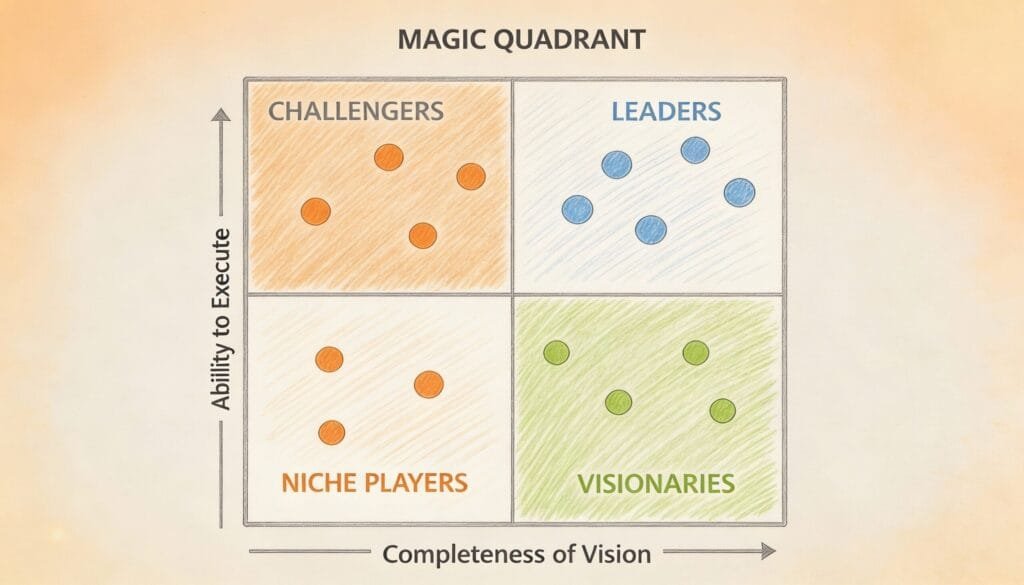
Imagine you’re at a party where everyone is standing in a room. The hosts have divided the floor into four squares with tape. People in the top right corner are the popular kids who also get good grades. People in the bottom left are the ones who just showed up and nobody knows yet. The other two corners? Those are where things get interesting.
That’s basically a Magic Quadrant.
The chart has two axes. The horizontal one measures “Completeness of Vision.” The vertical one measures “Ability to Execute.” Four quadrants emerge from where these lines cross. Gartner calls them Leaders, Challengers, Visionaries, and Niche Players.
But these labels are where the confusion starts. A “Niche Player” sounds like someone who should be ignored, but some of the most innovative companies live in that quadrant. A “Leader” sounds perfect, but they’re often the slowest to change. The names are marketing, not science.
The Top Right Box Isn’t Always Right
Leaders sit in the top right. They have both vision and execution. They’re the safe choice, the one your boss will approve without asking questions. This is where Microsoft, Oracle, and Salesforce tend to camp out across various Magic Quadrants.
Here’s the thing nobody mentions: being in the Leaders quadrant often means you’ve already won. You’re defending territory, not conquering it. Leaders are like successful restaurants that now have locations in airports. They’re everywhere, they’re reliable, and they’re rarely exciting.
This matters more than you’d think. If you’re a startup trying to disrupt an industry, buying from a Leader means buying from the company you’re trying to avoid becoming. If you’re a large enterprise that values stability over innovation, that’s exactly what you want.
The irony is thick here. The Magic Quadrant rewards companies for having vision, but once they reach the Leaders box, their primary job becomes protecting what they have. True vision becomes optional.
Visionaries Are Gambling on Tomorrow
The bottom right quadrant holds the Visionaries. They have great ideas and big ambitions but haven’t quite figured out how to deliver at scale. Think of them as the startup that just raised a Series B and is promising to change everything.
Visionaries are fascinating because they represent a bet. They’re betting they can execute before they run out of money. You’re betting they’re right.
Some of the most transformative technology purchases come from this quadrant. Cloud computing was once a Visionary play. So was containerization. So was almost every technology that later became standard.
But here’s what the Magic Quadrant won’t tell you: most Visionaries never become Leaders. They either get acquired, run out of steam, or discover their vision was more appealing in PowerPoint than in practice. The quadrant shows you where companies are, not where they’re going.
This creates a peculiar decision point. Do you want to work with someone who’s definitely figured it out, or someone who might figure out something better? The Magic Quadrant presents this as an analytical question. It’s actually a philosophical one.
Challengers Execute Without Vision
Top left is where the Challengers live. They’re good at what they do, but they’re not pushing boundaries. They’re the companies that saw what Leaders were doing, copied it effectively, and now compete on price or relationships.
Challengers are underrated. Not every technology decision needs to be visionary. Sometimes you just need something that works, costs less, and won’t give you headaches. Challengers are often former Leaders who got comfortable, or they’re regional players who dominate specific markets.
The real story with Challengers is about strategic clarity. They’ve decided not to chase every trend. They know what they’re good at and they stick to it. In a world where every company claims to be revolutionary, there’s something refreshing about a vendor that simply promises to show up and do the job.
But there’s a trap here too. Challengers are vulnerable. They’re one innovation cycle away from irrelevance. When Leaders decide to compete on price, or when Visionaries figure out execution, Challengers get squeezed.
Niche Players Are Where Innovation Hides
The bottom left quadrant holds Niche Players. This is supposed to be where companies go before they matter. Small vendors, regional players, specialists who only serve specific industries.
Except that’s not always true.
Some Niche Players are there because they’re solving problems so specific that Gartner’s broad criteria miss their value entirely. Others are there because they’re so new that they haven’t been properly evaluated yet. A few are there because they actively avoid the enterprise features that move you up the chart.
Think about it like food. Leaders are McDonald’s. Visionaries are the trendy fusion restaurant. Challengers are the reliable local chain. Niche Players? They’re the tiny Vietnamese place that only serves one thing, but it’s the best version of that thing you’ll ever taste.
The Magic Quadrant judges companies on completeness. But sometimes incomplete is exactly what you need. Sometimes you don’t want all the features. You want the three features that matter, done perfectly.
What the Axes Actually Measure
Let’s talk about what “Completeness of Vision” and “Ability to Execute” really mean, because Gartner buries the details in dozens of pages of methodology.
Completeness of Vision measures whether a company understands where the market is heading and has a credible plan to get there. But here’s the catch: Gartner decides where the market is heading. If your vision doesn’t align with Gartner’s view of the future, you lose points.
This creates a subtle bias toward consensus thinking. Companies that propose truly different futures, that zigging while everyone else zags, often score lower on vision. The quadrant rewards companies for agreeing with Gartner’s analysts, not for being right.
Ability to Execute is supposedly more objective. Can you deliver what you promise? Do you have customers? Are they happy? Can you scale?
But execution is measured partly through market presence and viability. Bigger companies score better. Companies with more revenue score better. This isn’t necessarily wrong, but it means the quadrant is measuring current execution, not future capability.
A small company with a perfect product might score lower on execution than a giant company with a mediocre product. Size gets rewarded. This is fine if you’re looking for safety. It’s problematic if you’re looking for excellence.
The Time Problem Nobody Discusses
Magic Quadrants are snapshots. They show you where companies were when Gartner did the research, which was months before you’re reading the chart.
In slow-moving industries, this doesn’t matter much. In fast-moving ones, it matters.
By the time a Magic Quadrant gets published, Visionaries might have figured out execution. Leaders might have lost key talent. Niche Players might have gotten acquired. Challengers might have launched the product that changes everything.
You’re making decisions about the future based on data about the past. Every investor knows this is dangerous. Yet somehow when the data comes in a colorful chart with “Magic” in the name, people forget.
The really tricky part is that vendors know this too. They time their announcements and product launches to coincide with Gartner’s research cycles. The Magic Quadrant doesn’t just observe the market. It shapes it.
What Gartner Doesn’t Tell You
Here’s something useful: Gartner makes money from the vendors they evaluate. Not directly for placement, they’re careful about that. But vendors pay Gartner for consulting, for access to analysts, for the right to use the Magic Quadrant logo in their marketing.
This doesn’t mean the research is corrupt. It means the incentives are complex. Gartner needs to maintain credibility with buyers while also serving vendors who fund much of their business. They generally do this well, but it’s worth knowing.
There’s also a self-fulfilling aspect. Being named a Leader helps you become more of a Leader. You can use it in sales. It builds credibility. It makes recruiting easier. The Magic Quadrant doesn’t just reflect reality. It creates it.
This is most obvious with smaller vendors. A Visionary placement can transform a company’s trajectory. Suddenly they’re credible in enterprise sales conversations. Suddenly their Series C round gets easier. The chart becomes the reality it claims to describe.
How to Actually Use This Thing
So you’ve got a Magic Quadrant in front of you. You need to make a decision. What do you actually do?
First, read the text. Everyone looks at the chart and ignores the report. The report is where the nuance lives. It explains why companies are where they are. It describes their strengths and weaknesses. The chart is a summary. The report is the substance.
Second, understand your own position. Are you trying to be safe or fast? Do you need every feature or just the core ones? Can you tolerate vendor risk in exchange for innovation? Your answer matters more than the quadrant placement.
If you’re a Fortune 500 company with compliance requirements and a risk-averse culture, Leaders make sense. If you’re a startup trying to move faster than your competitors, Visionaries or Niche Players might be exactly right.
Third, look at the trajectories, not the positions. The Magic Quadrant shows where companies are now. But the accompanying research often shows where they were in previous years. A company moving from Niche Player to Visionary is probably more interesting than a Leader who’s been in the same spot for five years.
Fourth, talk to users, not vendors. The Magic Quadrant tells you what Gartner thinks. User reviews and reference calls tell you what actually happens when the software meets reality. These often don’t match.
The Categories Nobody Examines
Every Magic Quadrant is for a specific market category. There’s one for CRM, one for cloud infrastructure, one for data analytics, and dozens more.
But who decides what the categories are? Gartner does.
This matters because category definitions shape which companies get compared. They determine what features count as “complete” and what counts as “niche.” They decide which vision is forward-thinking and which is off-topic.
Sometimes the category definitions are perfect. Sometimes they’re artifacts of how the market used to be organized, not how it’s evolving. Sometimes they split what should be unified or unify what should be split.
If a vendor is strong in an area that Gartner doesn’t consider core to the category, they’ll score lower. If the category definition favors a certain architectural approach, vendors using different approaches start at a disadvantage.
This is where reading multiple Magic Quadrants can be revealing. A company might be a Niche Player in one quadrant and a Visionary in another. That tells you something about where their actual strengths lie.
The Real Magic Trick
Here’s the thing about Magic Quadrants that makes them actually useful, despite all these caveats: they force structured thinking.
Before Gartner came along, people bought software based on golf games and steak dinners. They bought from whoever their friend recommended. They bought from whoever showed up first.
The Magic Quadrant’s real value isn’t that it gives you the right answer. It’s that it makes you ask better questions. It creates a framework for comparing vendors. It surfaces considerations you might have missed.
Think of it like movie ratings. No critic’s score will tell you if you’ll enjoy a film. But looking at scores from multiple critics, reading their reasoning, and understanding your own taste relative to theirs? That’s useful.
The Magic Quadrant works the same way. It’s not truth. It’s perspective. Use it as one input among many, not as a decision oracle.
Beyond the Chart
The smartest buyers don’t just read the Magic Quadrant. They read the Critical Capabilities report that usually comes with it. While the Magic Quadrant shows vendor positioning, Critical Capabilities scores vendors on specific use cases.
This is often more useful. A Leader might score highest overall but lowest for your particular use case. A Niche Player might be perfect for what you actually need to do.
Critical Capabilities forces you to think about what you’re trying to accomplish, not just which vendor is “best.” This is the right question. Technologies aren’t good or bad in the abstract. They’re good or bad for specific purposes.
What This Really Tells Us
Strip away the jargon and the Magic Quadrant is doing something simple: organizing complexity into a form humans can process quickly. It’s taking dozens of vendors with hundreds of features and thousands of data points and making them comparable.
That’s valuable. It’s also dangerous.
The danger comes when we forget that the simplification loses information. The chart is not the territory. The vendor’s position is not their value to you.
The best way to read a Magic Quadrant is skeptically but not cynically. Take it seriously as research while remembering it’s research with specific assumptions, specific biases, and specific limitations.
Use it as a starting point, not an ending point. Let it organize your initial thinking, then go deeper. Talk to users. Run pilots. Test things yourself.
The Magic Quadrant can tell you who the market thinks is winning. Only you can decide who’s right for you.
And maybe that’s the most important insight of all: in technology decisions, like in much of business, the consensus answer and the right answer are often different things. The Magic Quadrant shows you the consensus.
The rest is up to you.