Table of Contents
Every organization says it wants innovation. They hang posters about thinking differently. They hold brainstorming sessions with sticky notes. They talk about disruption over catered lunches.
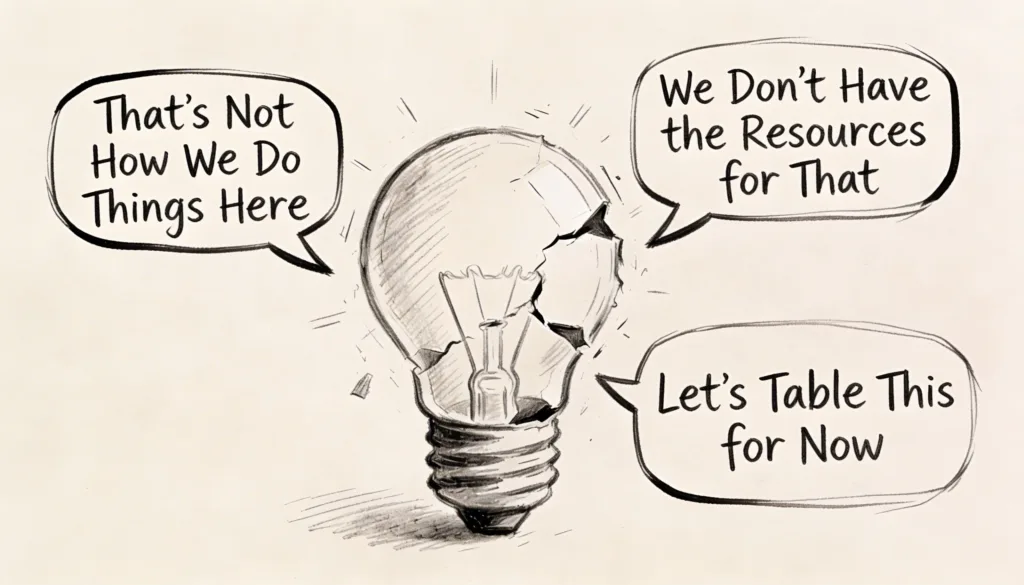
Then someone actually shows up with a good idea, and a middle manager says one of three magic phrases that makes it disappear.
These phrases work like organizational antibodies. They sound reasonable. They feel prudent. They let everyone nod along while the idea suffocates in the corner. The person who suggested it learns the real lesson: innovation is something we praise in the abstract and kill in the specific.
Understanding these phrases matters because middle managers are not villains. They operate in a peculiar kind of organizational purgatory. They face pressure from above to deliver results and pressure from below to protect their teams. A new idea represents risk, and risk in the middle layers of a company gets punished more often than it gets rewarded. The incentive structure practically writes the script.
But if you know the script, you can change the scene.
Phrase One: “That’s Not How We Do Things Here”
This phrase deserves a prize for efficiency. Six words that invoke tradition, dismiss novelty, and end the conversation. It treats the past as evidence rather than just a series of choices that people made when they knew less than you know now.
The beautiful irony is that every successful company once did things differently than everyone else. That was the entire point. Netflix mailed DVDs when Blockbuster charged late fees. Amazon sold books online when Barnes & Noble owned retail. Someone at those companies had to ignore this exact phrase, or we would all still be rewinding VHS tapes.
The phrase works because it smuggles in an assumption: the current way of doing things emerged from careful optimization rather than accumulated accidents. But talk to anyone who has worked at a company for a decade, and they will tell you about processes that exist because someone left, or a crisis happened, or a leader had a pet theory. The past is not a scientific experiment. It is a messy story we clean up in retrospect.
Middle managers use this phrase because precedent provides safety. If something goes wrong while following established protocol, you can point to the protocol. If something goes wrong while trying a new approach, you own the failure personally. The risk calculus is not about what works best. It is about what feels safest to the person making the decision.
How to respond: Ask what problem the current approach was designed to solve. Not in a hostile way, but genuinely. Most processes were solutions to problems that no longer exist, or they solved yesterday’s problem while creating today’s. When you understand the original purpose, you can show how circumstances have changed.
Then reframe your idea not as abandoning the old way but as updating it. “We started doing X because of Y, but now we face Z, so what if we evolved it this way?” You are not attacking their judgment. You are building on it.
If that does not work, propose a small experiment. The phrase gains power from the assumption that you want to overhaul everything. Take that weapon away. “What if we tried this with one team for one month?” Suddenly you are not threatening the system. You are gathering data. Data is respectable.
Phrase Two: “We Don’t Have the Resources for That”
This phrase sounds like math. Resources are finite. Your idea requires resources. Therefore, logic dictates we cannot proceed. The conversation ends with the satisfying feeling of having been reasonable.
The problem is that resources do not exist in some objective state waiting to be allocated fairly. Resources follow power and attention. Companies find money for the projects that executives care about, even if those projects have dubious returns. They discover budget for initiatives that make someone important look good. The resource conversation is never really about resources. It is about priority.
Consider how companies respond to crises. A security breach happens, and suddenly there are resources for a complete infrastructure overhaul. A competitor launches something threatening, and money appears for a response team. The resources existed all along. They just needed the right trigger to become visible.
What middle managers often mean by this phrase is: “We don’t have resources we can allocate without political consequences.” They are not wrong about the constraint. They are just misidentifying it. The constraint is not the budget. It is their authority to redirect it.
The phrase also reveals something counterintuitive about organizations. You might think resource allocation happens through rational planning, where ideas compete based on expected returns. But research on how organizations actually work shows that resource allocation is more like evolution. Projects survive by finding sponsors, building coalitions, and demonstrating early wins. The best idea without political support loses to the mediocre idea with an executive champion.
How to respond: Stop arguing that your idea deserves resources and start showing how it can succeed with almost none. Resourcefulness beats resources. Can you build a prototype with existing tools? Can you borrow an hour a week from willing people rather than asking for headcount? Can you prove the concept so cheaply that the resource question becomes irrelevant?
This approach works because it transforms the nature of the objection. If they say no to a free experiment that costs nothing, they are revealing that resources were never the real issue. Now you can have a more honest conversation about what actually concerns them.
You can also reframe resources as an output rather than an input. “I understand we are constrained now. What results would need to happen to make resources available?” This forces clarity about what success looks like and creates a roadmap. You are not demanding resources. You are asking what would earn them.
And if you really believe in the idea, consider the meta question: why should this organization be the one to pursue it? Maybe the answer is that it should not. Maybe you are in the wrong place, or the idea needs a different home. That is valuable information too.
Phrase Three: “Let’s Table This for Now”
This is the most elegant of the three phrases because it sounds like a postponement rather than a rejection. The idea is not bad. The timing is just off. We will definitely return to this later. The meeting ends on a positive note, everyone feels heard, and the idea enters organizational limbo where it will die quietly without anyone having to say no.
The phrase exploits a truth about organizations: they have terrible memories. What gets tabled rarely gets retrieved unless someone persistently brings it back up. And bringing it back up makes you look pushy or obsessed, so the social cost of persistence exceeds the value most people place on their ideas. The system filters for people who give up.
Tabling works as a rejection mechanism because it shifts the burden back to the proposer. Now you have to track the idea, wait for the right moment, and reintroduce it without seeming like you ignored the previous feedback. Most people lack the energy or political skill to do this well, so the idea fades.
The counterintuitive aspect here is that organizations often table ideas not because they are bad but because they are too good. A genuinely innovative idea implies change, and change creates winners and losers. Even if the organization as a whole would benefit, specific people might lose status, control, or relevance. Those people do not reject the idea outright, which would be obvious. They table it, which looks collaborative.
How to respond: The key is to refuse the table. Not aggressively, but structurally. Create forcing functions that prevent the idea from disappearing.
“I appreciate that timing is important. Should I schedule time in next month’s meeting to review this, or would you prefer I send a written update in two weeks?” You are agreeing to the delay while ensuring it has a specific endpoint. Vague tabling becomes concrete scheduling.
Or create external momentum. “That makes sense. I am going to keep developing this on the side. Would it be helpful if I shared early results as I go?” Now the idea has a life outside the official decision process. When you return with evidence of progress, the conversation changes.
You can also test whether the tabling is genuine by asking what would need to change for this to become a priority. If they cannot articulate conditions that would revive the idea, you know the table is a graveyard. Save your energy.
The nuclear option is to build the thing anyway. Not in a way that requires permission, but in a way that demonstrates value. Many successful internal innovations started as skunkworks projects that people built during the margins of their official work. By the time leadership noticed, the thing was already working. This requires political courage and surplus energy, but it sidesteps the entire approval process.
The Deeper Pattern
These three phrases share a structure. They sound like practical objections about operations, resources, or timing. But they function as social signals that enforce organizational norms. They tell you what kind of person succeeds here, what kinds of ideas are permissible, and what role you are expected to play.
The phrases also share a solution: demonstration over persuasion. Middle managers operate in environments where arguing for an idea feels risky but responding to results feels safe. If you can show rather than tell, you change the entire dynamic. This connects to a broader pattern in how change happens in organizations.
The formal innovation process exists mostly as theater. It gives executives something to point to when they talk about culture. The real innovation happens around it, through people who understand that getting permission is often harder than seeking forgiveness.
This creates an interesting paradox. Organizations need innovation to survive, but their immune systems are designed to reject it. The people who successfully introduce new ideas are not the ones who respect the system most. They are the ones who understand it well enough to work around it.
A Final Thought
The middle manager is not the enemy. They are trapped in a system that punishes initiative and rewards risk avoidance. If you want to change what happens to ideas in organizations, you have to change the incentive structure that shapes middle management behavior.
But until someone fixes that larger problem, you can at least stop letting these three phrases end the conversation. Recognize them for what they are: predictable resistance that sounds like reason. Then respond not by arguing harder but by changing the game.
Build the smallest version of your idea that demonstrates value. Find allies who benefit from the change you propose. Create evidence that makes saying no harder than saying yes. Turn the vague promise to revisit something later into a concrete date. Reduce the resource requirements until they become trivial.
Most importantly, remember that organizations do not adopt good ideas. People do. Your job is not to convince the abstraction called the company. Your job is to find the specific humans who have the authority, incentive, or courage to move forward, and make it easy for them to say yes.
The three phrases will not disappear. They serve too useful a function in the organizational immune system. But they only work if you accept them as final answers. Treat them instead as the beginning of a negotiation, and suddenly the game gets more interesting.